
Why do my Etsy competitors sell end grain boards for $35?
Because it is not the product you are making. A walnut and maple end grain board at 300x400x38 mm (12x16x1.5 in) costs a small shop about $180 in materials and hands-on hours, so nobody sells that at $35 on purpose. The $35 listing is one of three things: an edge grain or face grain board with "end grain" in the title, an imported acacia or rubberwood board bought wholesale at $10 to $15 and relisted, or a hobbyist who counted lumber and forgot waste, abrasives and time. Each one is visible in the photos if you know where to look, and none of them is a competitor you should price against.
You have run your numbers. Lumber, glue, sandpaper, oil, a box, and five hours of your own time. The sheet says $180 before any profit, and the market research says someone two listings down is selling "handmade end grain walnut cutting board" for $35 with free shipping and 400 reviews. It feels like either your math is wrong or the market is.
The math is fine. The listing is describing a different object. Below are the three objects that word covers at that price, what each one costs the seller, and the specific things in a product photo that give each one away.
What does an end grain board actually cost to make at that size?
Start from the number you are comparing against, because the whole argument rests on it. For a 300x400x38 mm board in hard maple and walnut, bought as rough 8/4 stock from a US hardwood dealer in 2026:
| Cost line | Amount |
|---|---|
| Lumber, 4.5 bf purchased including 30% waste | $38 |
| Titebond III for two glue-ups | $2 |
| Abrasives, 80 through 220 grit | $6 |
| Mineral oil and beeswax finish | $4 |
| Box, corner protectors, care card | $5 |
| Hands-on labor, 5.0 hours at $25 | $125 |
| Shop cost before profit | $180 |
Take labor out entirely and the board still eats $55 in materials. A $35 sale price at Etsy's 6.5% transaction fee, 3% plus $0.25 payment processing and a $0.20 listing fee nets about $31.30. Ship it inside the US at 2.4 kg and you pay $12 to $20 of that back to the carrier. Whoever is selling this is either not selling this, or not making money.
Is the $35 board really end grain?
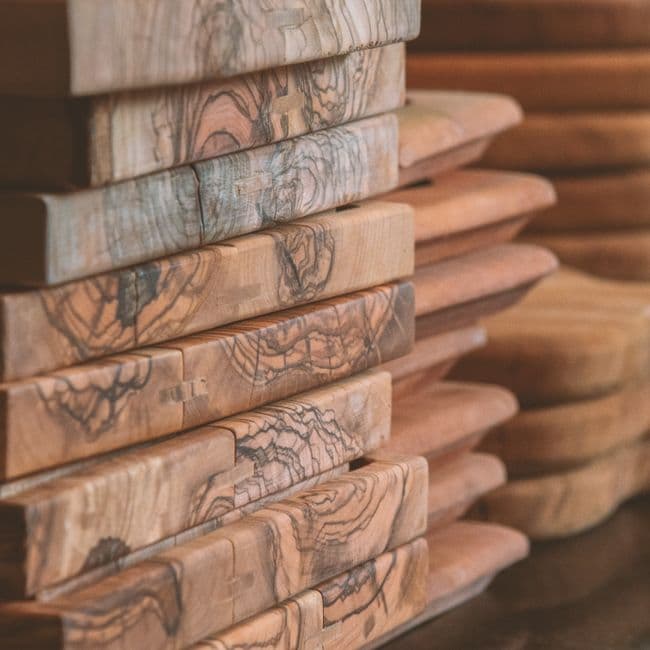
Most of the time, no. Etsy search rewards the keyword, so sellers of long grain boards put "end grain" in the title because it converts, and there is no review step that checks. What you are looking at is usually a face grain board, sometimes edge grain, in a species that photographs warmly.
The check takes ten seconds and a photo of the cutting surface, shot straight down:
| What you see on the working face | What it is |
|---|---|
| Long continuous stripes or cathedral arches running across the board | Face grain or edge grain |
| Small blocks, each showing curved growth-ring arcs, often a checkerboard of two tones | End grain |
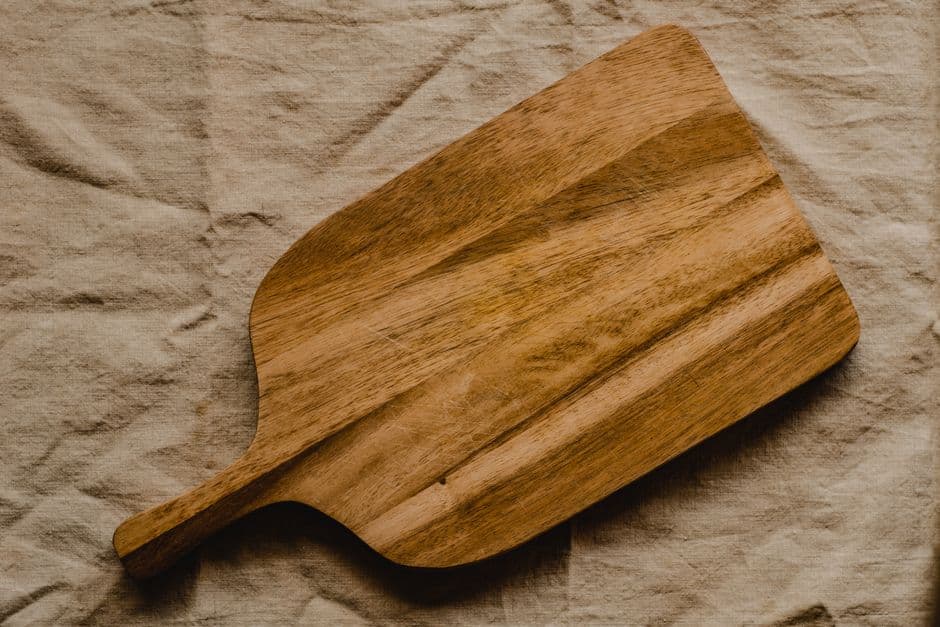
| A single wide plank with a handle cut out of the same piece | Face grain, one board, no glue-up at all |
A second tell is the edge of the board. On an end grain board the sides show long grain, so the stripes run along the edge and the blocks sit on top. On an edge grain board it is reversed. If the listing has no straight-down photo of the surface, and every shot is angled with a lemon on it, that is a choice the seller made.
Where do the genuine end grain boards at $35 come from?
Some of them are real end grain, and those are imports. Acacia and rubberwood end grain boards are made at scale in Vietnam, Thailand and China, sold to US importers at roughly $8 to $15 per board depending on size and volume, and turn up on Amazon and in big-box kitchen aisles at $25 to $45. An Etsy seller who buys a case of 24 and lists them as "handmade" is reselling, and the platform's handmade policy technically allows it if they claim to have "designed" the product.
These boards are a specific product with a specific look:
| Sign in the listing | Why it points to import |
|---|---|
| Acacia, rubberwood or "hevea" as the species | Plantation timber at a fraction of walnut's price, not sold by US hardwood dealers as 8/4 stock |
| Thickness of 19 to 25 mm (0.75 to 1 in) | Factories run thin to save material; a shop-made end grain board is 32 to 45 mm because thin end grain cracks |
| Uniform 30 to 40 mm squares with random color mixing across the whole face | Blocks cut from mixed offcuts and glued in a press, no designed pattern |
| Juice groove and rounded handle cutouts on every size | CNC features that only pay at volume |
| Same photo set across five different shops | Supplier stock photos |
The imports are real end grain, made from wood that costs a tenth of walnut, flattened on a wide-belt sander that costs more than your car, and boxed by someone paid a few dollars an hour. A $35 acacia board is priced correctly for what it is. It is not priced against you.
Could a real maker be selling at $35 and just not know it?
Yes, and this is the third bucket. It is smaller than the other two, and it is the one that quietly disappears from search within a year.
The pattern is a hobbyist with a garage shop and a spreadsheet that has one line on it. They bought a board of walnut for $28, made one board from it, and priced at $35 because that felt like a profit. Waste is not on the sheet because the offcuts are still in a bin. Sandpaper was already in the shop. The five hours were a Saturday. The mineral oil came from the pharmacy for $6 and covered ten boards.
They will do this for eight or twelve boards and then stop, because each one costs them a Saturday and a trip to the lumber yard for a $7 return. The listing stays up with its reviews for a long time after the shop goes quiet, and that is what you are seeing when you search: a graveyard of correctly made boards priced by people who were paying for the hobby.
The photos give this away too. Real end grain, a real designed pattern, a non-standard size, 38 mm thick, and a shop with fewer than 50 sales and a processing time of two or three weeks.
How do I sort a listing in under a minute?
Work through the photos in this order and stop at the first hit:
- Find a straight-down shot of the cutting face. Stripes running the full length mean it is not end grain, and you can close the tab.
- Read the species and thickness. Acacia or rubberwood under 25 mm is an import.
- Check the pattern. Random color mixing in identical squares is press-glued factory stock. A deliberate checkerboard, chevron or brick with consistent strip widths is shop work.
- Look at the shop page. Twenty listings in five sizes with identical photo styling and a one-day ship time is a reseller. Six listings, made to order, three-week processing is a maker.
If a listing survives all four, you have found a real maker at $35, and you can leave them alone. They are not making money, and a year from now they will not be there.
Which price should I actually set?
My position: ignore the $35 boards completely when you set price, and use them only in your product copy. A buyer who searched "end grain cutting board" and saw twelve listings at $30 to $45 arrives at your $220 board already skeptical. Answer the question they have not asked yet. One photo of your cutting face straight down, one photo of the edge showing the long grain, a stated thickness in both millimeters and inches, and a line that says the board is 38 mm hard maple and walnut, glued up twice in this shop. That copy does more than any price cut, because the $35 buyer was never going to spend $220 anyway, and the $220 buyer wants a reason.
Where you do have to compete is against other makers at $150 to $260, and there the only lever that matters is knowing your own cost precisely. Endgrain Studio does the material half of that from the pattern: draw the board, enter your kerf and lumber prices, and it gives you the cut list, the board feet including waste, and the material cost of that specific pattern. Switch from a checkerboard to a 3D cube and the waste line moves with it. Time your own hours once with a phone on the bench and you have a cost sheet that tells you where $180 becomes $195 and where you can hold at $170.
Can a real end grain board ever sell near $35?
Only by changing the board. A 200x250x25 mm (8x10x1 in) maple board in a simple two-species stripe, batched six at a time, uses about 1.2 bf of lumber and 70 minutes of hands-on time per board once the milling is shared. Materials $16, labor $29, cost $45. That still does not reach $35, and it is a thin board that will need a warning about not soaking it.
The honest conclusion is that a shop-made end grain board has a floor somewhere around $60 to $75 for a small format, and the $35 listings are below that floor because they are a different product. Pricing your board to match them means paying the customer to take it.