
My Board Cracked Along the Glue Line, What Did I Do Wrong?
A crack that follows the glue line almost always means the joint was starved of glue, the mating faces were not flat, or the two species on either side of the seam moved by different amounts as the board dried out. Look at the failure surface before you blame the glue: a clean shiny line means the bond let go, while torn wood fibers on both halves mean the wood tore instead and moisture or clamping stress is the real cause. Titebond III needs continuous squeeze-out along the whole seam and roughly 150 to 250 psi of clamping pressure on hardwood, and stock at 6 to 8 percent moisture content.
The board sat in the clamps overnight, came out flat, went through the sander, and two weeks later there is a hairline running down one seam. Every forum answer says "bad glue joint" and stops there, which helps nobody. Four different mistakes produce a crack in the same place, and each one leaves a different fingerprint on the failed surface.
Is this a glue failure or a wood failure?
Pry the crack open a little with a thin blade and look at what is showing.
If both faces are smooth and you can see the shiny film of dried glue on one or both sides, the adhesive let go of the wood. That is a bonding problem: not enough glue, too much clamping pressure, a dirty or burnished surface, or glue that skinned over before the clamps went on.
If the crack runs slightly off the seam and you see torn fiber on both halves, the glue held and the wood gave up. Wood failure at a properly glued joint means the stress exceeded what maple can take, and that stress came from moisture change or from a species pairing that moves at different rates.
That single check saves you from fixing the wrong thing. I have watched people buy a fresh bottle of Titebond III to solve what was actually a 12 percent moisture content problem.

Which mistake starves a glue joint?
A starved joint has too little glue left between the surfaces to form a continuous film. It happens two ways, and beginners usually cause the second one while trying to be careful.
The obvious way is spreading too thin. PVA needs to wet both faces, and end grain drinks it, so a light smear on one face and nothing on the other leaves dry patches you cannot see once the panel closes.
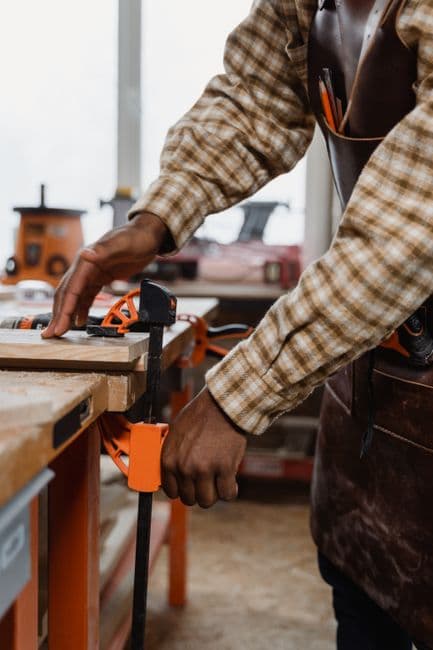
The other way is clamping too hard. Squeeze the joint past roughly 250 psi and you push glue out faster than it can cure in place, especially in the first minute when it is still liquid. On a 50 mm wide by 400 mm long joint face, 250 psi works out to about 4.5 kN of force, which two decent parallel clamps deliver without much effort from your wrist. Past that point you are pumping the joint dry.
| What you see | Most likely cause | What to change |
|---|---|---|
| Shiny glue film on both faces | Over-clamped, glue squeezed out | Back off to snug plus a quarter turn |
| Dry patch, no glue at all in one area | Spread too thin or missed | Glue both faces, look for full squeeze-out |
| Rubbery beads, joint opens easily | Glue skinned before clamping | Cut assembly time, work in sections |
| Torn fiber on both sides | Wood movement or moisture stress | Check moisture and species pairing |
| Gap tapers from one end | Mating face was not flat | Joint or sand the panel faces first |
How long is too long between spreading and clamping?
Titebond III gives about 10 minutes of open time at 21 degrees C and 50 percent humidity. That is generous compared with Titebond II at around 5 minutes, and it is why III is the sensible default for an end grain glue-up with 20 strips in the row.
Those numbers collapse in a warm shop. At 27 degrees C with a fan running you get closer to 6 minutes, and the strips you glued first have already skinned over while you were still spreading the last ones. A skinned surface still feels wet and still squeezes out, so the joint looks correct and fails months later.
The fix is boring and effective. Glue up in sections of four or five strips, let each section set for half an hour, then join the sections. It costs an afternoon and removes the single most common cause of a second glue-up failure.
Why does the crack appear weeks later instead of at the clamps?
Because the board has to lose moisture first. Kiln dried hardwood arrives at 6 to 8 percent, a lumberyard rack in a humid summer can push it to 10 or 12 percent, and a heated kitchen in January pulls it down toward 5 percent. That swing shrinks the wood, and the shrinkage is not the same in every strip.
Hard maple shrinks 9.9 percent tangentially and 4.8 percent radially from green to oven dry. Black walnut shrinks 7.8 and 5.5. Cherry shrinks 7.1 and 3.7. Alternate maple and walnut strips in a checkerboard and every seam between them carries the difference, which is why the crack picks the seam and not the middle of a square.
The practical rules that come out of those numbers: buy kiln dried stock, let it sit in your shop for a week before you cut anything, and check it with a pin meter rather than trusting the sticker. When you mix species with a large tangential gap, such as white oak at 10.5 against cherry at 3.7, keep the individual squares smaller so no single seam has to absorb much movement.
Could the surface prep be the problem?
Two prep mistakes show up constantly in cracked boards.
The first is a hollow face. Rip a strip on a saw with a fence that is a hair out of parallel and the face comes off slightly convex. Clamp two convex faces together and the middle touches while the ends do not, so the glue line is fat at the ends and starved in the middle. A joint like that survives the clamps and splits at the first crosscut.
The second is a burnished surface. A dull blade heats the cut and closes the pores, which leaves the wood glossy and much harder to wet. If your rip cuts come out with brown scorch marks, the blade needs cleaning or replacing before it needs anything else.
Where does planning stop the crack before it happens?
Most of what causes a glue line failure gets decided before the saw runs: how wide the squares are, which species sit next to each other, how thick the strips go into the second glue-up, and how many seams the panel carries. Endgrain Studio works out that geometry from the pattern you draw, gives you the strip list with real widths for your blade kerf, and prints a cut list you can hang on the wall. When you know that a design puts 21 seams in a 305 mm board, you know before buying wood that it wants a species pairing that moves together rather than maple against purpleheart.
Can the cracked board be saved?
Sometimes, and the decision hangs on how deep the crack goes.
A hairline that stops in the top few millimetres and does not run through the thickness can be flooded with thin CA glue, clamped, and flattened. It stays visible, and I would keep that board for my own kitchen rather than sell it.
A crack you can see on both faces means the seam has parted through the whole thickness. Repairing that with glue leaves a joint weaker than the one that already failed, and this is a board that gets washed and loaded every day. Cut the panel apart at the failed seam on the table saw, re-square the two halves, and glue them back up as one narrower board. You lose 5 mm of width and keep a board you can stand behind.
What goes on the wall before the next glue-up?
Measure moisture content and refuse to cut anything above 8 percent. Spread glue on both faces until squeeze-out runs the whole length of the seam. Set your clamps snug plus a quarter turn instead of leaning on the handle. Glue in sections of five strips when the shop is warm, and check every mating face against a straightedge before it goes into the clamps.