
Why are end grain cutting boards so expensive to buy?
An end grain board costs three to four times what a plain edge grain board costs because it takes two separate glue-ups, a full crosscut cycle in between, and a flattening step that no thickness planer will do for you. On top of that, roughly a third of the hardwood you buy never reaches the finished board: kerf, milling and trim eat it. For a 300x400x38 mm walnut and maple board that is about $38 of lumber inside roughly $55 of materials and consumables, plus 5 hours of hands-on work. Bill those hours at $25 and the board has already cost the shop $180 before any margin, which is why honest listings sit between $150 and $290 instead of near the $22 you pay for a factory edge grain board.
The question usually arrives with a screenshot attached. A walnut and maple checkerboard board, 12 by 16 inches, listed at $195, next to a big-box board at $22. Same species of object, same job in the kitchen. The gap looks like a markup for the word artisanal.
What the gap actually measures is a count of operations. The $22 board went through one glue-up and one sanding pass on a production line. The $195 board went through two glue-ups on opposite axes, a crosscut cycle in between, a flattening step that cannot be done on a planer, and about a third of its lumber went into the dust collector on the way. Every one of those steps has a price, and they add up in a predictable, boring way.
What am I actually paying for at $195?
Here is the breakdown for a 300x400x38 mm (12x16x1.5 in) board in walnut and hard maple, priced at US hardwood dealer rates in 2026 rather than big-box rates.
| Line item | Cost | Note |
|---|---|---|
| Rough lumber, 4.5 bf | $38 | 8/4 walnut at $12/bf, maple at $6/bf, blended |
| Waste already inside that figure | (about 30%) | kerf, milling, trim |
| Titebond III, roughly 90 g | $2 | two glue-ups, both sides of every joint |
| Abrasives, 80 to 220 grit | $6 | end grain kills discs fast |
| Mineral oil and wax finish | $4 | three coats over two days |
| Packaging and care card | $5 | box, corner protection, printed insert |
| Consumables subtotal | $55 | before any labour |
| Labour, 5 hours at $25/hr | $125 | hands-on only, not clamp time |
| Shop cost | $180 | |
| Retail with a normal margin | $250 to $290 |
The $195 listing you were looking at is a maker charging below that. Plenty of them do, which is a separate problem covered in what to charge for a board.
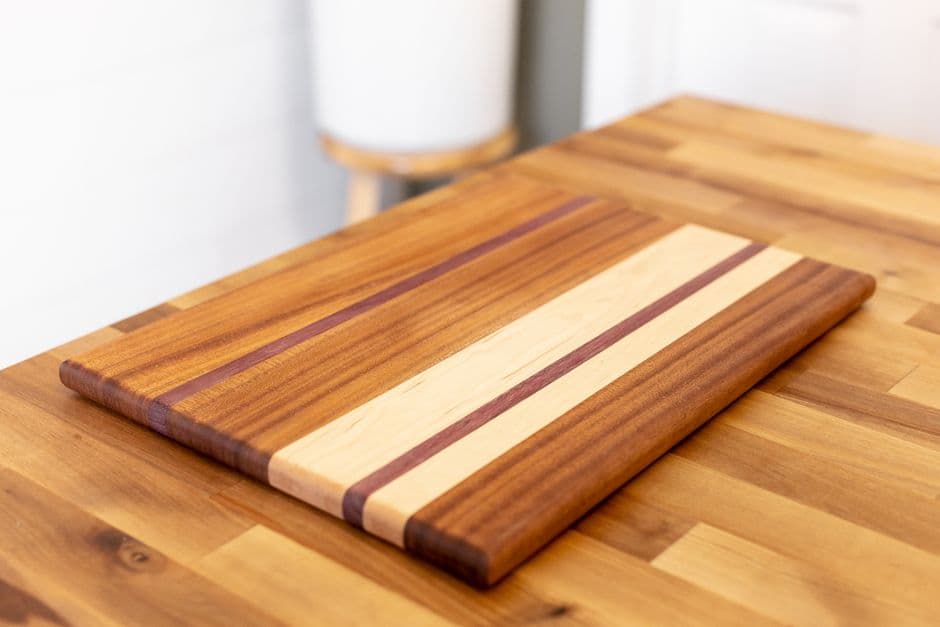
Why does an end grain board need twice the work of an edge grain one?
An edge grain board is one glue-up. You mill strips, glue them edge to edge, flatten, sand, oil, done. An end grain board uses that glued panel as raw material: it gets sliced across the grain into 15 or 20 pieces, each piece is rotated 90 degrees so the end grain faces up, and then the whole thing gets glued a second time.
That second glue-up is the hard one. You are now joining 15 pieces whose mating faces were cut by a saw blade, not by a jointer, and any piece that is 0.3 mm out of square shows up as a step in the finished surface. It also means two full clamping cycles of 12 to 24 hours each. The board occupies a bench and a set of clamps for two days without anyone touching it, which is why small shops batch boards rather than making them one at a time.
How much of the wood ends up on the floor?
More than most buyers expect, and this is the part that surprises even new makers. A 3.2 mm saw kerf across 16 crosscuts removes 51 mm of panel length before anything else happens. Milling rough lumber to square loses another 3 to 5 mm per face. Trimming the finished board to a clean rectangle takes 6 to 10 mm off each edge.
| Loss source | Typical share of purchased lumber |
|---|---|
| Kerf on both glue-up stages | 8 to 12% |
| Milling rough stock flat and square | 10 to 15% |
| Final trim and edge cleanup | 5 to 8% |
| Total | 25 to 35% |
At 30% waste, the 4.5 board feet you buy becomes about 3.1 board feet of finished board. The kerf and milling waste budget goes into the arithmetic properly, but the headline is simple: you pay for wood that goes in the bin, and so does the maker.
Can a machine not do this cheaply?
Only partly, and the exception is expensive. You cannot run an end grain board through a thickness planer without a serious risk of the knives tearing chunks out of the vertical fibres, which is its own long argument. The safe options are a drum sander (a 16 inch machine runs $1,500 to $2,500), a router sled, or a belt sander and patience.
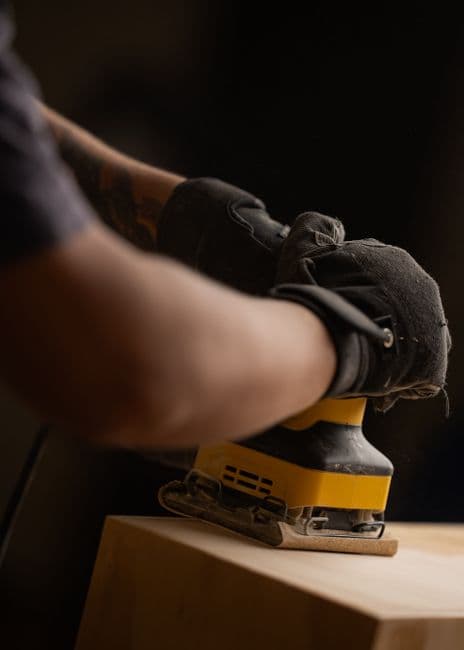
A drum sander turns 40 minutes of flattening into 8, so a shop making 20 boards a month pays it off in a year. A shop making 3 boards a month does not, and that maker is standing there with an orbital sander for half an hour per board, which lands right back in the labour line of the table above.
Where do the hours actually go?
| Operation | Time for one board |
|---|---|
| Milling rough stock square | 45 min |
| First glue-up, layout and clamping | 40 min |
| Crosscutting the panel into slices | 30 min |
| Second glue-up, flipping and clamping | 50 min |
| Flattening | 30 to 60 min |
| Sanding 80 through 220 | 60 min |
| Chamfer, juice groove, feet | 25 min |
| Oiling, three coats | 20 min spread over two days |
That is about 5 hours of hands-on work spread across three or four days of calendar time. A maker who quotes you two weeks is not stalling. Glue and oil set on their own schedule.
So why do I see $35 end grain boards online?
Almost all of them fall into a few buckets. Some listings are edge grain photographed at an angle that hides the grain direction, which is worth checking by asking for a photo of the cutting surface straight on. Some are imported acacia or rubberwood boards bought wholesale at $12 and resold, which are genuinely end grain but made from cheap species in a factory with automated flattening. And some are hobbyists who counted lumber but not waste, not abrasives and not hours, and are effectively paying for the privilege of making boards.
None of the three is a fake product exactly. They are different products at the same word.
Is $200 a fair price, or am I being taken?
My position: for a board in walnut, cherry or maple, from a maker in the US or EU, at 300x400 mm and 38 mm thick, $180 to $260 is fair and anything under $120 should make you ask what got skipped. Below that number, either the wood is a cheap species, the flattening was rushed, or the seller has not run their own numbers.
What I would push back on is the $400-plus board with an exotic species and a marketing story. Purpleheart and padauk look striking, and they also move more than maple with humidity, which is a durability trade you are paying extra for. A well made maple and walnut board will outlive a fancier one in a kitchen that swings between winter heating and summer humidity.
How do I check the numbers myself?
If you are buying, you can price the lumber yourself: find the species in a hardwood dealer's price list, multiply the board's volume by 1.4 for waste, and see whether the asking price leaves a plausible amount for hours.
If you are the one making them, Endgrain Studio does this from the pattern rather than from a guess. You draw the board, and it returns the cut list, the first glue-up panel size with kerf already accounted for, the total board feet including waste at your blade thickness, and a cost figure with your own lumber prices in it. That last number is the one to build a price on, because it is the only one that changes when your pattern gets more complicated.
Does a more complex pattern cost more to make?
Yes, and roughly in proportion to the number of distinct pieces. A simple striped board has 12 to 15 strips. A 3D cube pattern has three species cut at angles with far more offcut, and waste can pass 40%. That is not the maker inflating the price for looks. Angled cuts throw away triangles that no other board can use.